Walk down a residential street in almost any British town and you are reading a timeline of taste. The wide, flat-fronted house with evenly spaced sash windows is a different creature from the narrow terrace with a bay and a tiled path, and both differ again from the airy Edwardian semi behind its hedge. Knowing which period you are looking at — and why it looks that way — makes decorating far easier. It also stops you buying the wrong things.
Georgian: Order, Symmetry and Quiet Colours
Georgian houses went up between roughly 1714 and 1830, and their guiding principle was order. Builders worked to classical proportions: windows stacked in neat vertical lines, the front door dead centre, rooms taller than they were wide. If you live in one, you probably already feel that calm — and how much it depends on keeping things symmetrical.
The tell-tale details are six-over-six sash windows with slim glazing bars, a fanlight above the door, internal shutters folding into the window reveal, and a shallow cornice with a simple picture rail beneath it. Fireplaces tend to be marble and restrained, with a slate or stone hearth. Decoration was quiet by later standards: soft greens, stone, grey-blues, ochre, occasionally something bolder on doors and woodwork. Panelling does much of the work. You can move a modern room towards the period simply by painting a dado or adding a well-proportioned picture rail.
Victorian: Layered, Patterned, Proud of It
More housing survives from this period than any other, which is why "Victorian" gets used so loosely. Covering 1837 to 1901, it spans decades of industrial expansion and mass production. Ornament became cheap and plentiful, and people used a lot of it. Fronts are usually narrow, with a bay window, a recessed porch, and a mix of brick, stucco or terracotta.
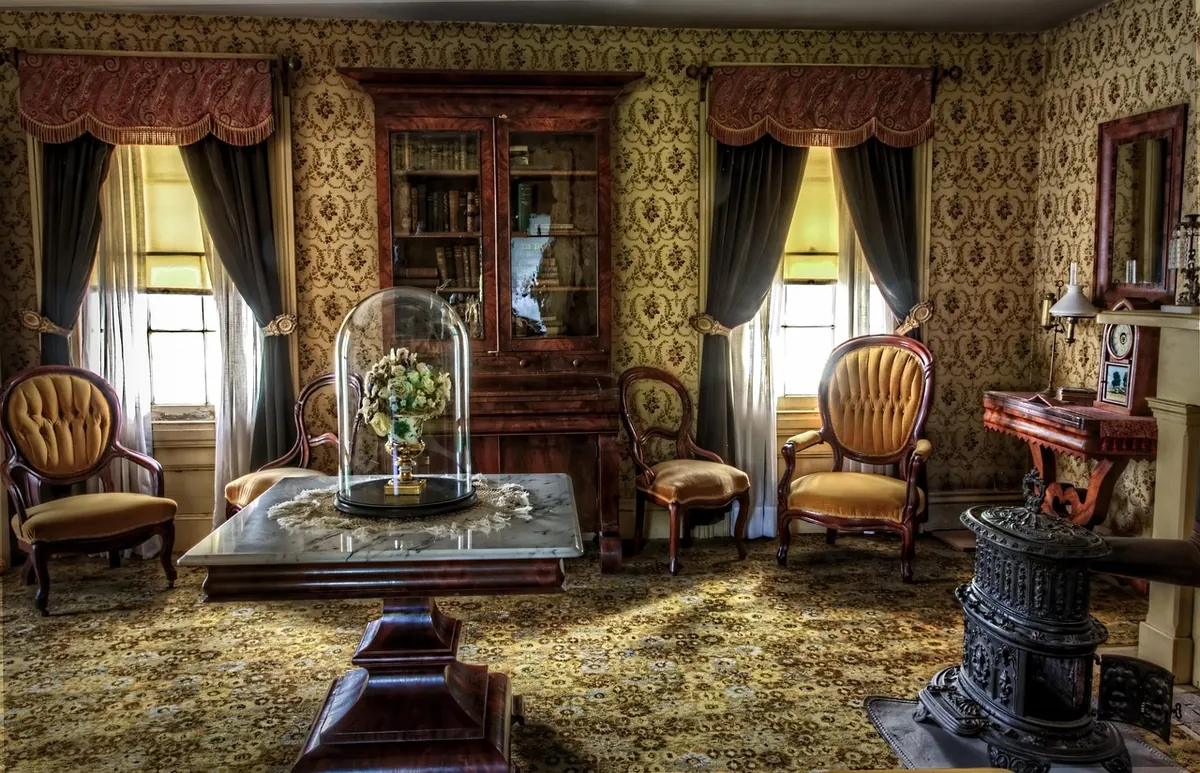
Inside, the hallway sets the tone: encaustic floor tiles, a dado rail with the dado painted darker than the wall above, deep coving and a ceiling rose. Fireplaces are cast iron with tiled inserts and a wooden or marble surround, though later examples get simpler. Walls carried pattern on pattern — a bold paper above the dado, something plainer below, a carpet with its own design. Colours were rich: deep reds, forest greens, aubergine, gold.
This is the style people most often get wrong. Copying it wholesale feels heavy, especially in a small room with a low ceiling. Borrow the structure instead — dado rail, cornice, one good fireplace — then use a single strong pattern rather than five.
Edwardian: Lighter, Airier, Closer to the Garden
Edwardian covers 1901 to 1910, though the look carried on to the First World War. Houses are wider and shallower, set further back from the road, with bigger windows and fewer but larger panes. You will often see half-timbered gables, roughcast or tile-hung walls, and a bay that wraps around a corner. Gardens became a selling point, so windows and doors were placed to look out at them.
Decoration loosened up. Rooms are brighter, with lighter walls in cream, sage and soft grey, and simpler fireplaces — sometimes a deep inglenook with seats either side. Built-in cupboards, plate racks and window seats appear. The Arts and Crafts movement left its mark in honest materials: oak, brick, hand-printed papers. Where Victorian rooms layer pattern and colour, Edwardian rooms layer texture and light.
How to Tell Them Apart at a Glance
- Windows. Georgian: six-over-six sashes with fine glazing bars. Victorian: larger panes, often one-over-one or two-over-two, frequently in a bay. Edwardian: wide windows with top lights and fewer bars.
- Frontage. Georgian: flat, symmetrical, plain brick or render. Victorian: bay, porch, polychrome brick, decorative detailing. Edwardian: wider, gabled, roughcast or tile-hung.
- Hallway. Georgian: stone or timber floor, plain walls. Victorian: encaustic tiles and a strong dado. Edwardian: still tiled, but lighter and usually wider.
- Ceilings. Georgian: modest cornice, tall rooms. Victorian: deep coving and ceiling roses. Edwardian: simpler mouldings, generous height.
- Fireplaces. Georgian: marble, plain, symmetrical. Victorian: cast iron with tiled cheeks. Edwardian: wooden surrounds, sometimes an inglenook.
Adapting Period Style in a Modern Home
You do not need to live in a period house to use these styles, and you do not need to be slavish if you do. Work with what is already there, then add in the right order.
- Keep original features. Cornices, skirting, doors and fireplaces are expensive to replace and hard to fake convincingly. Repair and repaint before you redecorate around them.
- Match the palette to the light. Dark, rich colours suit tall, well-lit rooms. In a low-ceilinged Victorian terrace, use the strong colour on the dado or the woodwork and keep the walls lighter.
- Get the scale right. A large pattern needs a large room. In small spaces, choose a smaller repeat and repeat it less often.
- Layer your lighting. Period rooms were lit by fire and lamps. Two or three low-level sources on dimmers will do more for atmosphere than one central fitting.
- Buy one good piece rather than five adequate ones. A single well-chosen antique mirror or pair of curtains reads better than a room full of reproductions.
Where to Start This Weekend
Pick one room and one detail. Paint large test patches of your chosen colour on two walls, because British light changes everything, and live with them for a few days. If you want a quick, low-risk shift, fit a picture rail, paint the dado a shade darker than the wall, or swap a modern fire surround for something with the right proportions.
Before buying anything, measure twice and photograph the room in daylight. If you are altering a listed building or a property in a conservation area, check what permissions apply before you make changes — your local planning authority can confirm this, and it is worth the phone call.
Photo: Severinson / Pixabay